 |
 |
Airbus A321 Spotting Guide
The first derivative of the Airbus A320 was the stretched Airbus A321, also known as the Stretched A320, A320-500 and A325.The A320 was stretched by 22' 9" into the A321 via plugs in front of and behind the wing. The A321 became the longest fuselage member of the A320 family.
It is a narrow-body, single-aisle airliner, with 6-across seating. Typical 2-class seating capacity is 185 passengers, with a maximum of 236. The 321ceo has a range of 3,200 nm.
The A321 measures 146' 0" (44.51m) in length.
Airbus A321 Background and Development
The first flight of the Airbus A321 occurred in March of 1993, when the prototype, registration F-WWIA, flew with IAE V2500 engines; the second prototype, equipped with CFM56-5B turbofans, flew in May.
Lufthansa and Alitalia were the first to order the stretched Airbuses.
Today, the A321 is a major competitor as a replacement aircraft for the Boeing 757 which is no longer in production but remains a popular component in the fleet of many airliners. Its main competitor is the Boeing 737.
The A321 features an identical flightdeck to the smaller A319 and A320, and has the same type rating as those aircraft.
Airbus A321 Original Models
The two original models were the A321-100 and the A321-200, an extended range version of the -100.
The -200 has higher thrust engines and an additional fuel tank, resulting in an increase in range by 350 nautical miles. Externally, the two models are the same. Original models were referred to as A321ceo (Current Engine Option).
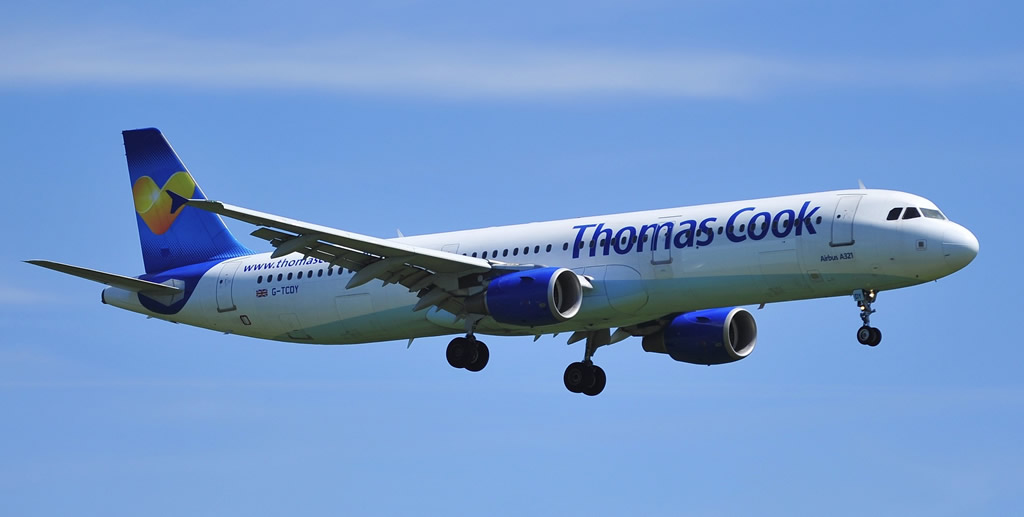
A321-211 G-TCDY of Thomas Cook Airlines (Photo by DELEHELLE Eric) |
 |
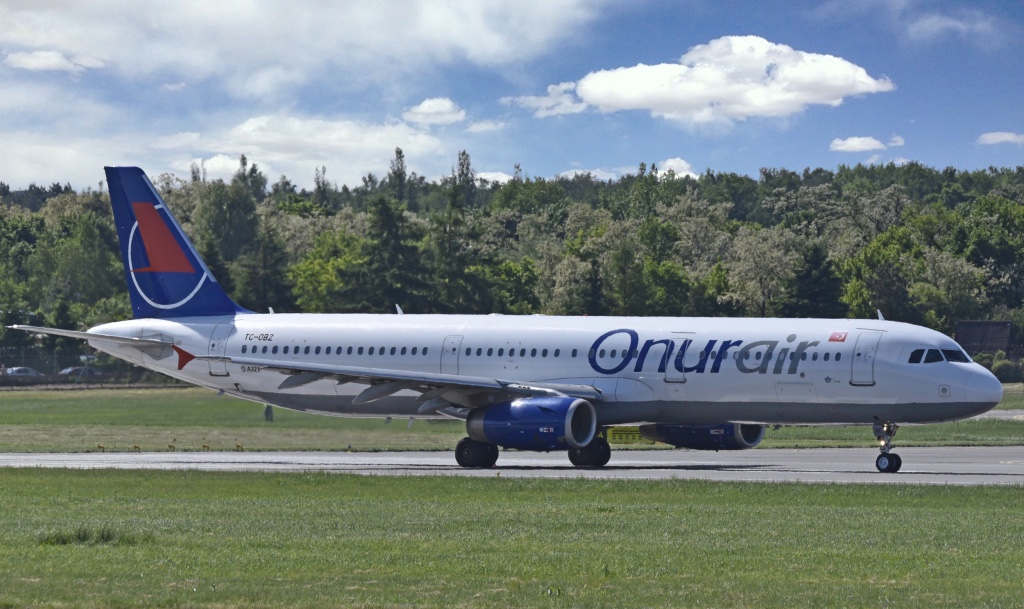
Airbus A321 of Onurair, Registration TC-OBZ (Photo by DELEHELLE Eric) |
 |
A321neo and A321LR
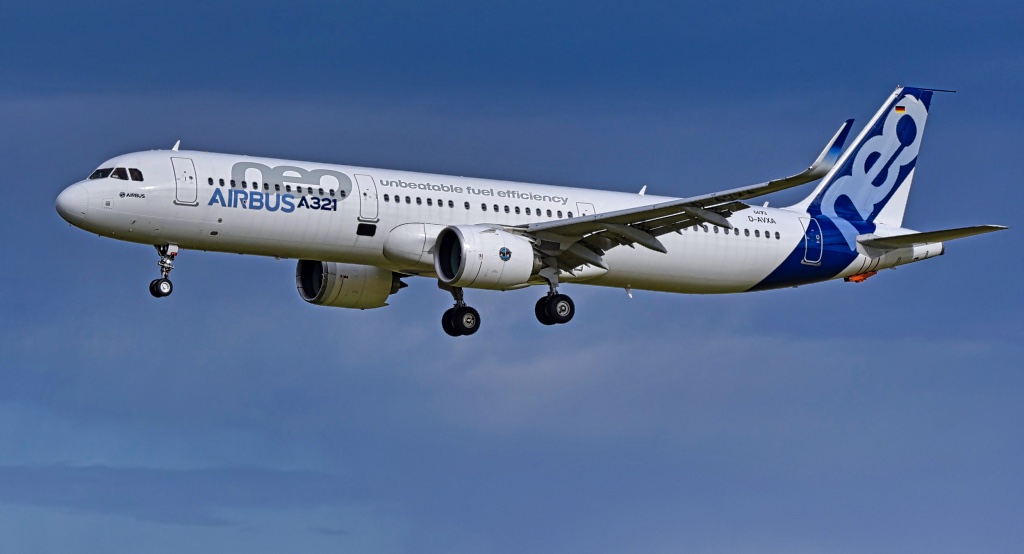
Newer versions include the A321neo (New Engine Option) and the A321LR (Long Range), and feature "sharklets" on the wing tips to improve performance. Some later model A321ceo aircraft also feature sharklets.
On the A321neo, Airbus expanded seating capacity with optimized use of cabin space, increased exit limits and a new cabin door configuration. This “Cabin-Flex” option increased the jetliner’s maximum capacity to 244 seats, while still providing high levels of passenger comfort.
The A321LR variant provides extended range for the A320neo Family’s longest fuselage version, able to fly routes of up to 4,000 nm with 206 passengers by utilizing extra fuel in three Additional Centre Tanks (ACTs).
Ideally suited to transatlantic routes, the A321LR allows airlines to tap into new long-haul markets that were not previously accessible with current single-aisle aircraft.
The A321LR made its maiden flight on January 31, 2018.
Airbus A321neo (Photo by DELEHELLE Eric) |
 |
A321XLR
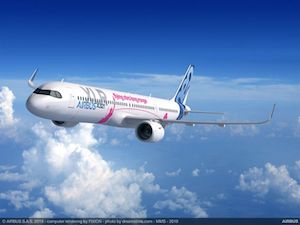 Airbus A321XLR (Photo courtesy of Airbus) |
Announced in 2019, the A321XLR is extending the single-aisle jetliner availability as Airbus’ next evolutionary step for the A321neo Family.
This longest-fuselage A321 variant can fly routes of up to 4,000nm with 206 passengers in its A321LR (long range) configuration, with extra fuel carried in three Additional Centre Tanks (ACTs). The A321XLR version provides a further range extension to 4,700nm. Its increased maximum take-off weight (MTOW) of 101 tonnes enables the aircraft to be fitted with a permanent Rear Centre Tank (carrying 12,900 litres of fuel) and an optional forward ACT.
This gives the A321XLR a flight time of up to 11 hours, with passengers benefitting throughout the trip from Airbus’ award-winning Airspace interior, which brings the latest cabin technology to the A320 Family.
Read more at the official website of the Airbus A321XLR
Airbus Cabin Flex (ACF) Models
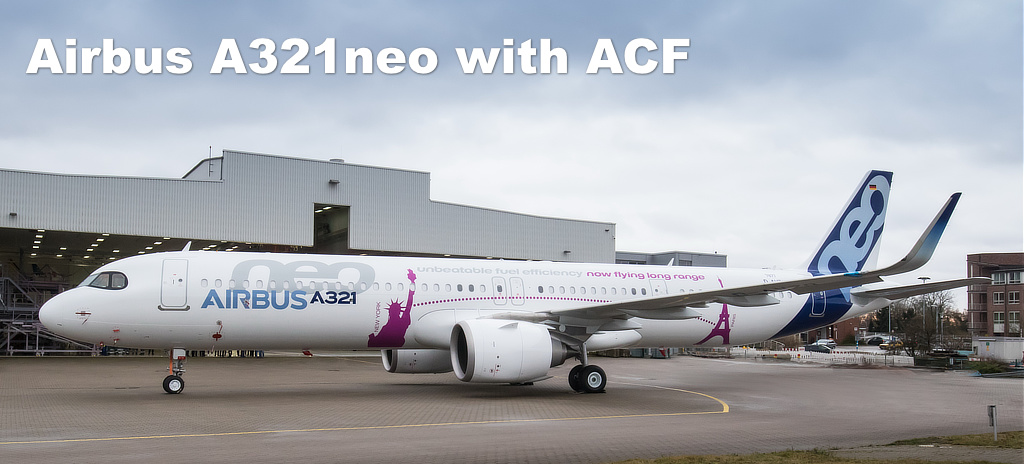
Shown below is the Airbus A321neo with Airbus Cabin Flex (ACF) Configuration This configuration has door 2 removed, and replaced by a double-overwing exit. Also in this configuration, door 3 is moved further aft. This configuration is reported to allow a maximum passenger capacity of 240. Airbus and Saab collaborate on the design and manufacture of ACF components. Photo courtesy of Airbus ... roll out the first A321neo ACF (Airbus Cabin Flex) in Hamburg with the Eiffel Tower in Paris and the Statue of Liberty in New York illustrating its transatlantic flight capability on its livery. |
 |
Airbus A321 Spotting Guide
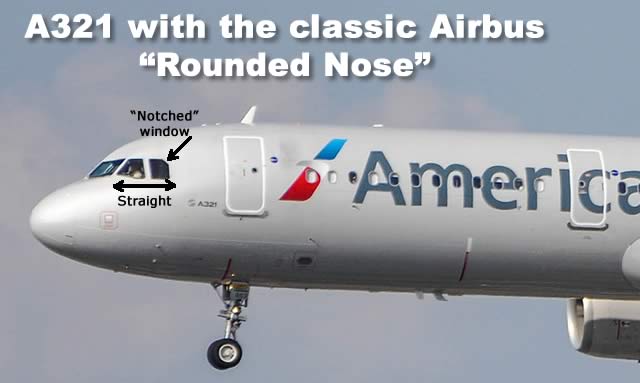
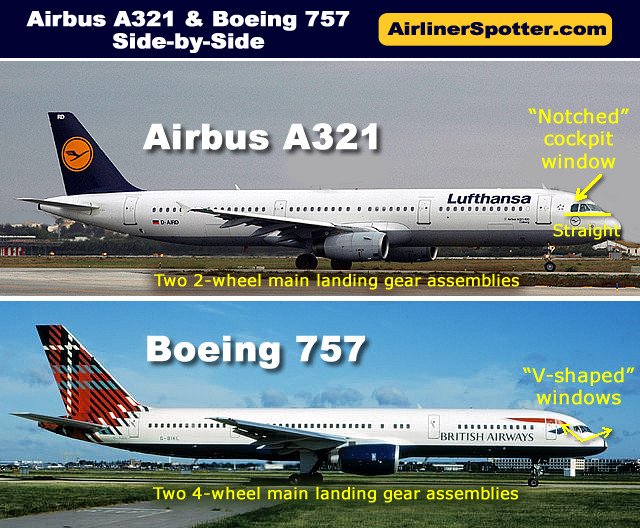
| The A321 has two engines under the wings, two dual-wheel main landing gear, four cabin doors evenly spaced along the fuselage, and the classic Airbus nose featuring the "notched" window. Some later models, like the A321neo with ACF, feature different cabin door placements. |
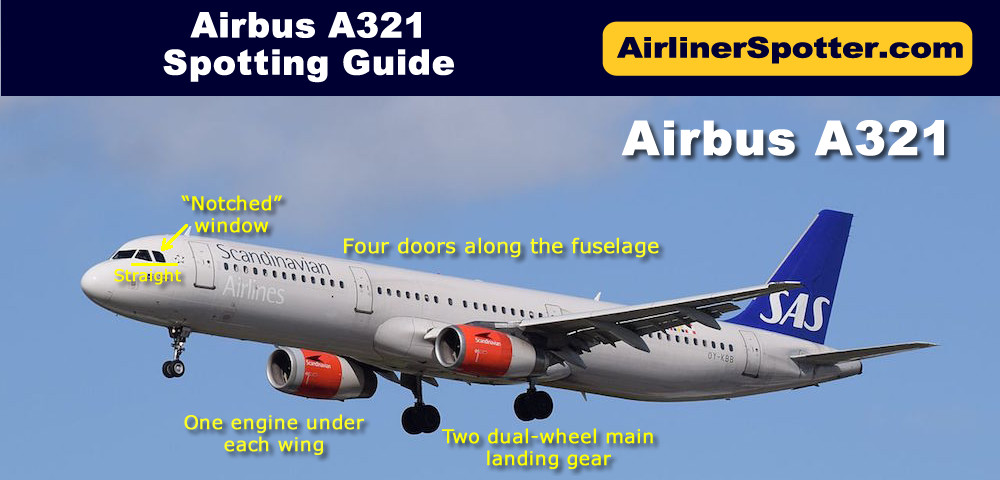
| The Airbus A321 features typical A320-series characteristics including the "rounded nose" and windshield straight across the bottom, and rear cockpit windshield window "notched" at the top corner. |
 |
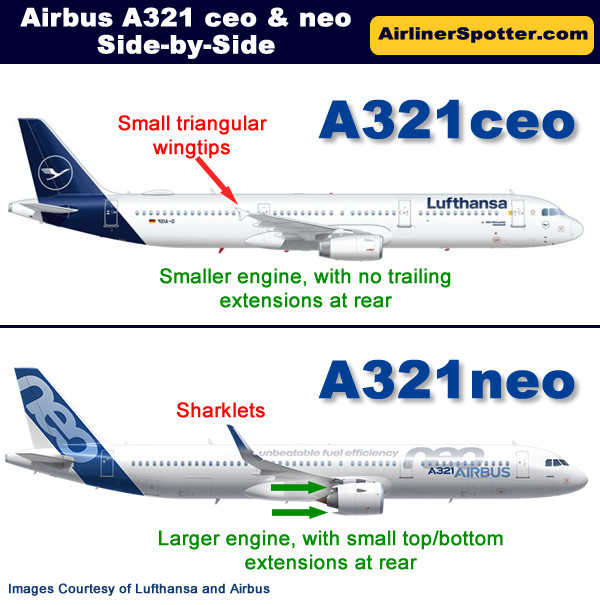
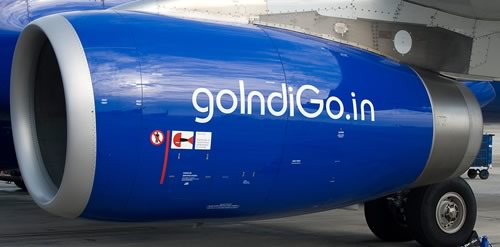
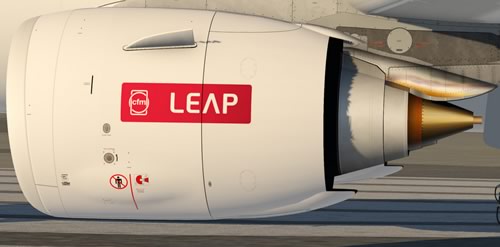
A321ceo vs A321neoShown below is a side-by-side comparison of the Airbus A321ceo and A310neo. The major visible, external differences lie in the engines and wingtips. The A321ceo has smaller engines. The A321ceo has small, triangular wingtips. In addition to being standard on A321neo aircraft, sharklets became available for newer-production A321ceo versions, and offered as an a retrofit solution on earlier-built A321-series aircraft. |
||
|
Airbus A321 vs Boeing 757Chart showing a side-by-side comparison of the Note that the A321 has two 2-wheel main gear assemblies, while the 757 has two 4-wheel landing gear. |
 |
Airbus A321 Orders and Deliveries
Total Airbus A321 orders and deliveries are shown in the table below (through October 2025). View current Orders/Deliveries from Airbus.
| Airbus A321 Model | Orders | Deliveries |
| A321 (ceo) | 1,784 | 1,784 |
| A321neo | 7,248 | 1,896 |
Airliner Spotting Guide for the Airbus A320 Family
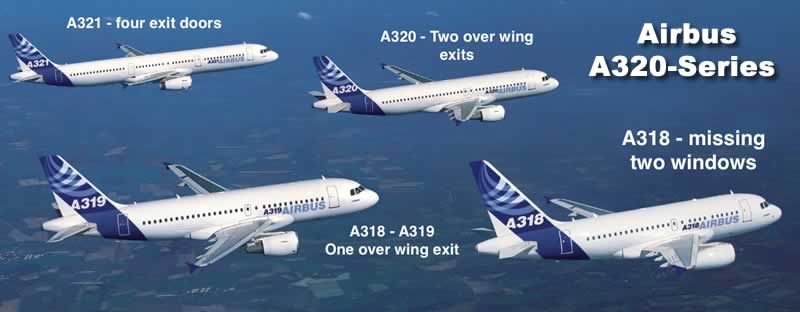
The Airbus A321 is part of a short-to-medium range, twin-engine, narrow-bodied A320 series. The family, seen below, includes the original A320, the stretched Airbus A321 (1994), the shortened A319 (1996), and the even smaller A318 (2003). For more information on the A320 family, visit the official website of Airbus Commercial Aircraft |
|
More Airbus A321 Photos
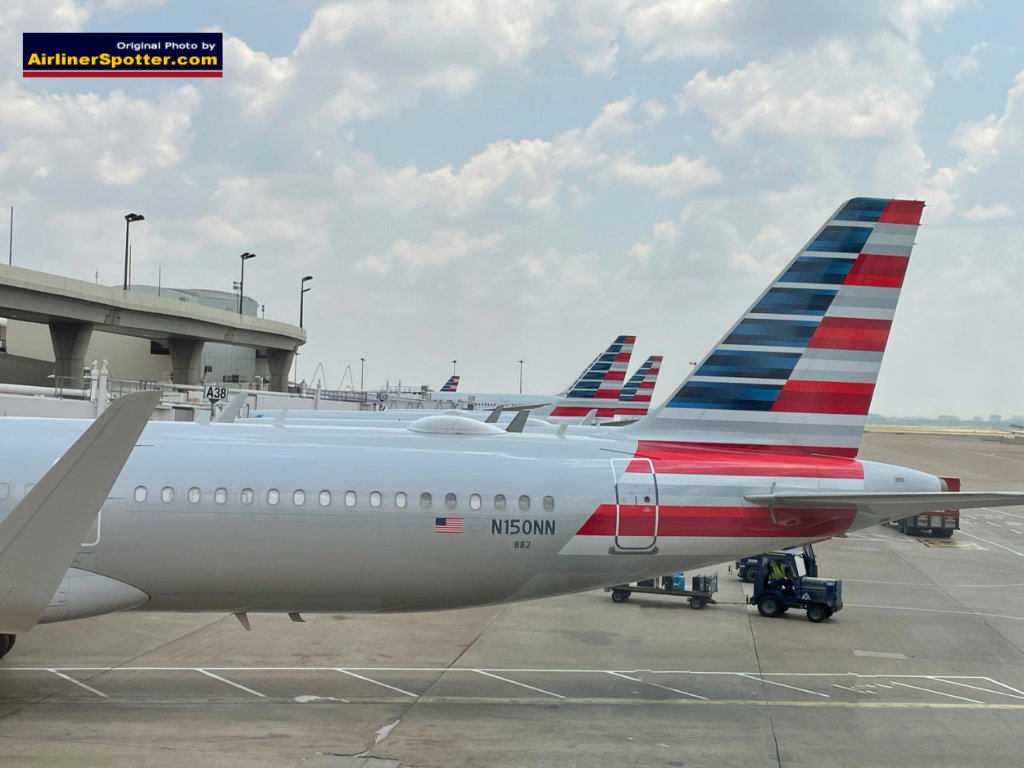
American Airlines Airbus A321-231, Registration N150NN, at Dallas-Fort Worth International Airport (DFW). Delivered on November 14, 2015. Airbus Construction Number 6828. AA Fleet Number 882. (Staff Photo) |
 |
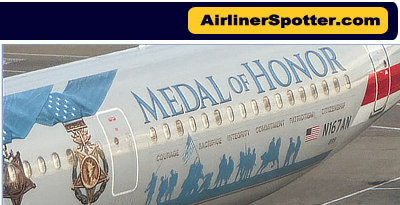
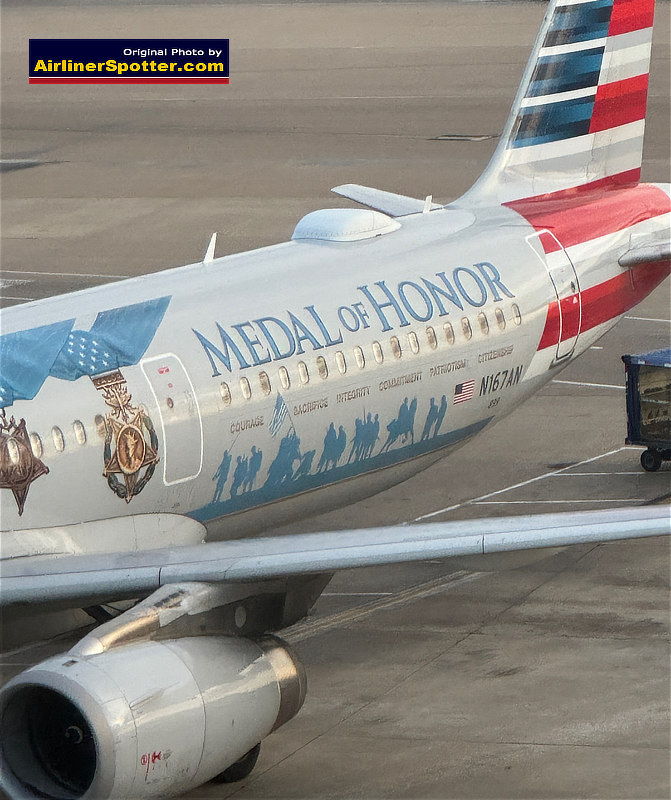
American Airlines Airbus A321-231, Registration N167AN at Dallas-Fort Worth International Airport (DFW). In special Medal of Honor livery: Courage, Sacrifice, Integrity, Commitment, Patriotism, Citizenship (Staff Photo, July 5, 2024) |
 |
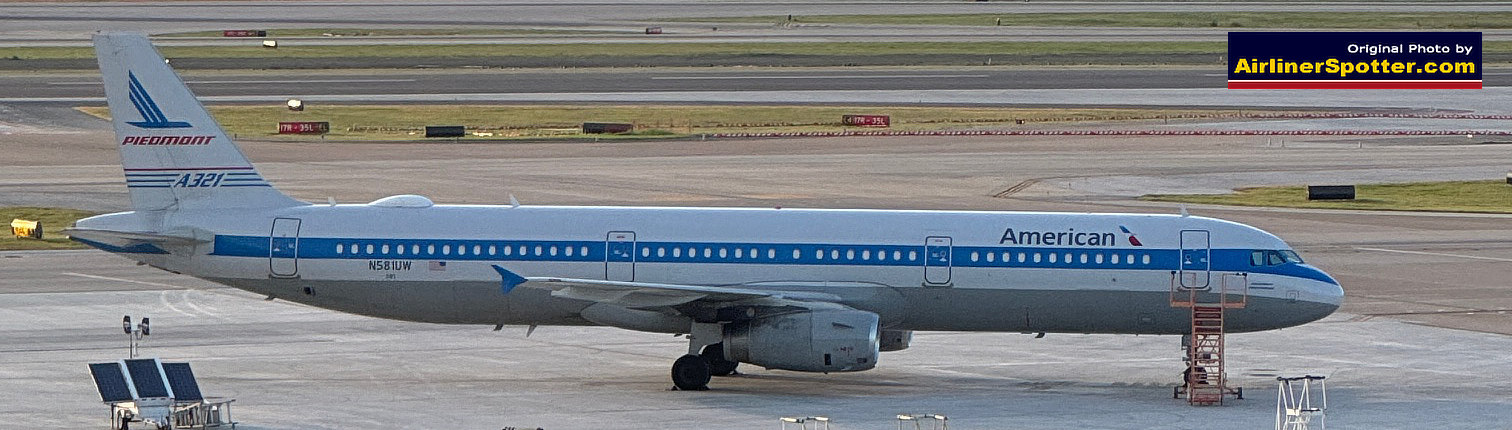
American Airlines Airbus A321-231, Registration N581UW at Dallas-Fort Worth International Airport (DFW). In Piedmont Airlines livery (Staff Photo, July 5, 2024) |
 |
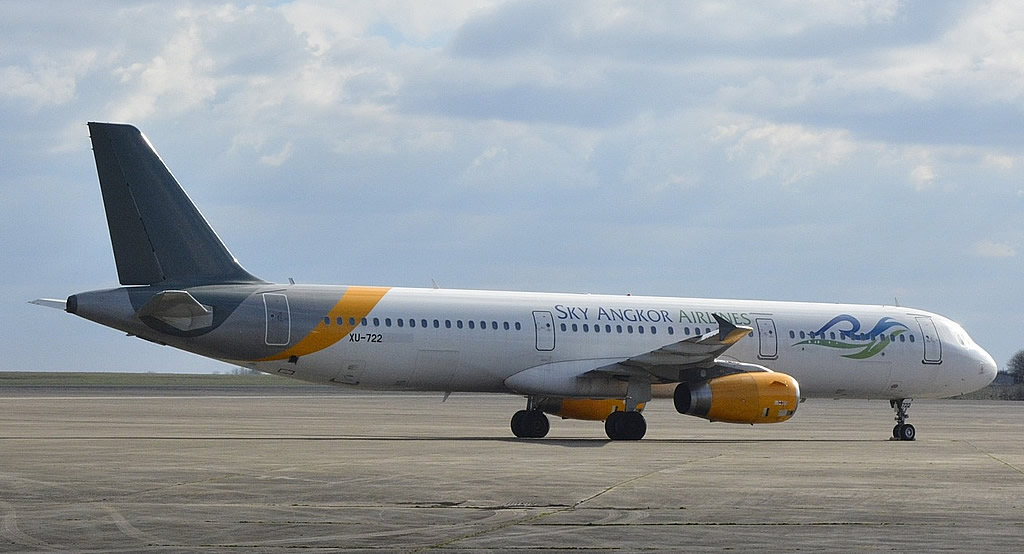
Airbus A321 XU-722 of Sky Angkor Airlines (Photo by DELEHELLE Eric) |
 |
Airbus A321 CS-TRJ of the Belgian Air Force (Photo by DELEHELLE Eric) |
 |